
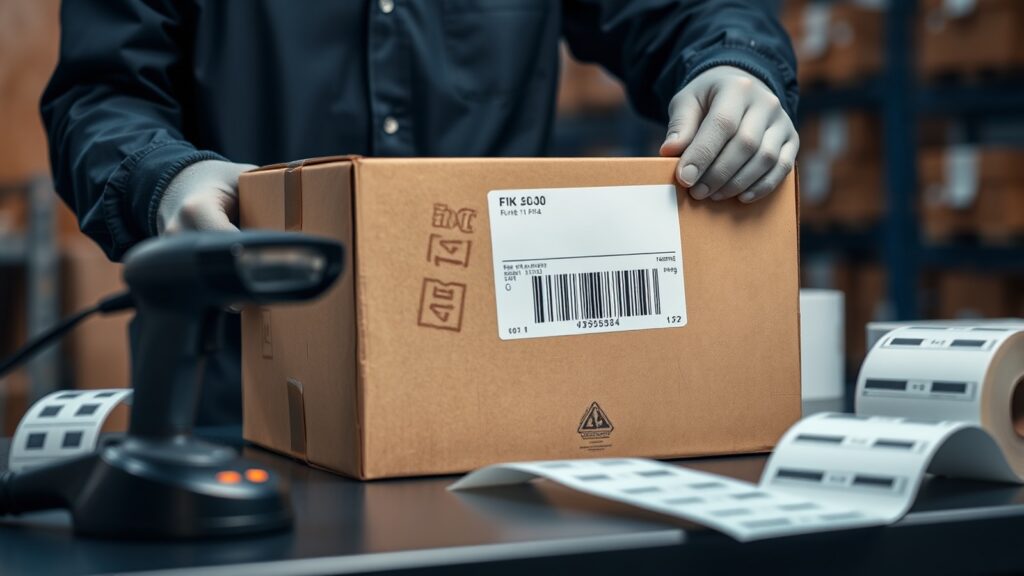
One product’s packaging often carries two barcodes: one is its identity card across every retail channel on earth; the other is its name inside Amazon’s warehouses. Confusing the two can cost you an entire shipment rejected at the FBA dock.
FNSKU and UPC: what relation
UPC is the universal product code, issued through GS1, following the product: same product, any seller, any channel — same UPC. FNSKU is Amazon’s internal identifier, following the seller × product pair: the same product sold by two sellers means two FNSKUs. When the warehouse scans an FNSKU it learns whose inventory ledger to credit — UPC answers *what this is*; FNSKU answers *whose this is*.
When FNSKU labels are mandatory
Commingled inventory (stickerless) historically let certain products check in on UPC alone, pooled with other sellers’ identical units. Amazon has announced commingling ends March 31, 2026 — inbound goods will as a rule require FNSKU labels (current Amazon policy governs). We advised labeling even before the change: pooled inventory shares quality by lottery — another seller’s defective or counterfeit units ship to your customers and land on your account. Never worth the sticker saved. Whether the factory labels or the US warehouse does is really a piece of the first-leg decision: direct-to-FBA means the factory gets one chance; staging buys an American fix-it point.
The three relabeling scenarios
- Channel or store moves: stock shifting from store A to store B, or off Amazon entirely — FNSKUs recoded and relabeled, or stripped back to UPC
- Batch reconfiguration: bundles split to singles, singles built into bundles, revised listings — codes follow the new SKU definition
- Error recovery: misprints, wrong labels, transit damage — intercepted and relabeled at the warehouse, one of the commonest steps on the returns-refurbishment line
Custom packaging: beyond the sticker
The warehouse can do more than labels: thank-you cards and manuals inserted, gifts added, gift-box and bundle repacks, outer-carton remarking. One universal rule: packaging changes change weight and dimensions — recheck the final-mile billing basis and the platform’s prep specs afterward, and never let a thank-you card push a shipment into the next billing tier.
What a wrong label costs
The light version: check-in rejection, rebooked appointments, storage burning while the goods wait. The heavy version: inventory contamination — product A scanned into product B’s ledger, then months of complaints, returns and unbalanceable books. The unglamorous defense: scan-verify a sample after every labeling run (the listing that comes up must match the physical goods), and keep per-batch labeling records with photos.
Land the labels in America
SKYCARGO INC’s Los Angeles and Oregon warehouses run FNSKU labeling, relabeling and custom packaging, connected to the import chain. For per-step pricing and turnaround, ask us. (Personal shipments: Shiptw.)
Platform labeling and prep rules update continuously; current Amazon policy and quotes govern. Reference only.