

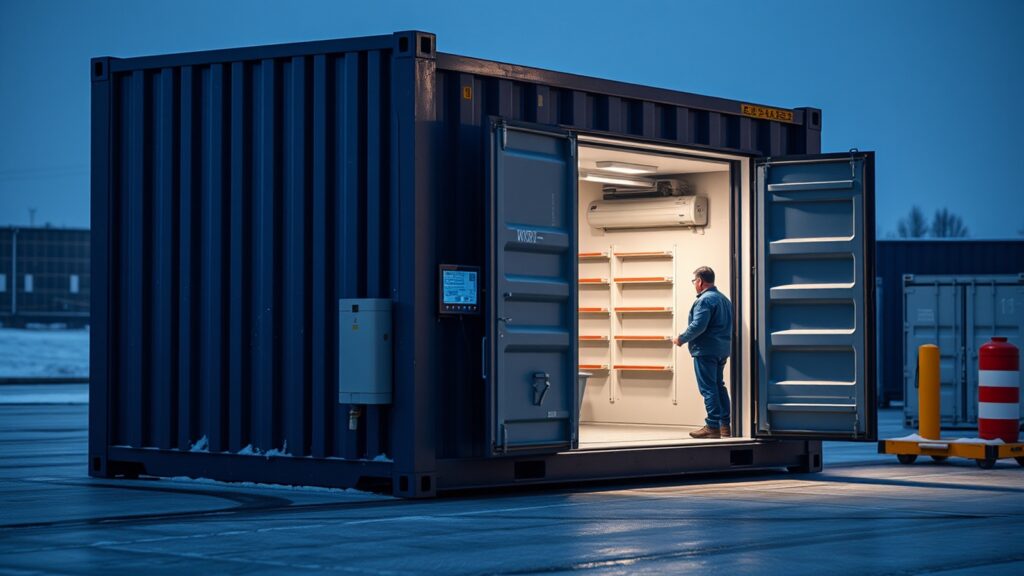
The most unjust cargo loss in the claims files looks like this: the reefer unit ran perfectly the whole voyage, the temperature log a flat line — and the doors open on a container of thawed goods. The machine did not lie; it measures return air, and the cargo was warm the moment it was loaded. Most reefer losses happen outside the machine.
The pre-cooling argument: should the box be cold before loading?
The commonest conflict at origin: the factory insists on chilling the empty container first; carriers near-universally instruct no pre-cooling — load on arrival. The reason is physics: open the doors of a pre-chilled box and humid ambient air rushes in, condensing and frosting on walls and evaporator, so the unit sails carrying a layer of ice. The correct division:
- Do not pre-cool the box; pre-cool the cargo: goods must reach carriage temperature in the cold room first — a reefer is designed to hold temperature, not to pull a warm load down to it
- Load fast: dock-seal the cold room, minimize door-open time, keep the cargo cold from store to seal
- Exceptions follow the carrier: some closed-dock operations permit pre-cooling — per booking instructions, never the factory’s own call
Which is why “box temperature at arrival” is not the acceptance issue — cargo temperature entering the box is. Probing and recording it at loading is the origin side’s cheapest self-protection.
Setpoint is not cargo temperature; vents are not decoration
The panel setpoint is the unit’s target for return or supply air — not your cargo’s temperature. Load warm goods and the recorder still shows the setpoint zone: the anatomy of the opening case. The setpoint must be specified by the cargo owner per product (frozen, chilled, respiring produce all differ) and written into the shipping documents alongside the temperature-record responsibilities.
Vents are the other switch strangers love to touch: frozen cargo runs vents fully closed for a sealed loop; only respiring produce needs ventilation, opened to the product’s specification. A helpful hand opening the vents on a frozen load lets humid air stream in all voyage — frost, frequent defrost cycles, temperature swings.
Loading: the airflow path is the lifeline
Reefer air supplies from the T-bar floor, flows through the stow, returns at the ceiling. Three rules:
- Never block the floor: no solid flat coverage of the T-rails; palletize to keep the bottom path through
- Leave the return layer: never stow above the load line — packed to the ceiling short-circuits the loop
- Stop short of the door end: leave the tail space so air can return
However cold the cargo and however new the unit, a blocked path warms the mid-stow — and the return sensor may never notice.
Power gaps: three legs plus one exam station
A reefer lives on shore power or a generator; break the risk down by leg: terminal — plugged to reefer points after gate-in, watch the gaps between gate-in and plug-in, unplug and loading; vessel — ship’s power with routine checks, the steadiest leg; drayage — genset-powered, the practical high-risk leg: confirming genset fuel and function before pickup is the receiving side’s job; and the exam station — cargo pulled by CBP for examination can sit off-power in transfer and queue, so cold-chain exam handling must be pre-arranged with the broker and station — a trap importers discover on their first selection. Each leg has a different responsible party, and the first question in any claim is “which leg lost power” — the reason an independent logger rides inside the stow, not just the unit’s own record.
Write the operations into an SOP — not site habits
SKYCARGO INC operates food and temperature-controlled export from booking setpoints through loading guidance to exam temperature continuity. Tell us the product and its temperature needs and we will reply with the reefer operating points for your lane. (Personal shipments: Shiptw.)
Carrier reefer procedures and product temperature specs vary; this is general practice. Carrier instructions and product specifications govern. Reference only.