

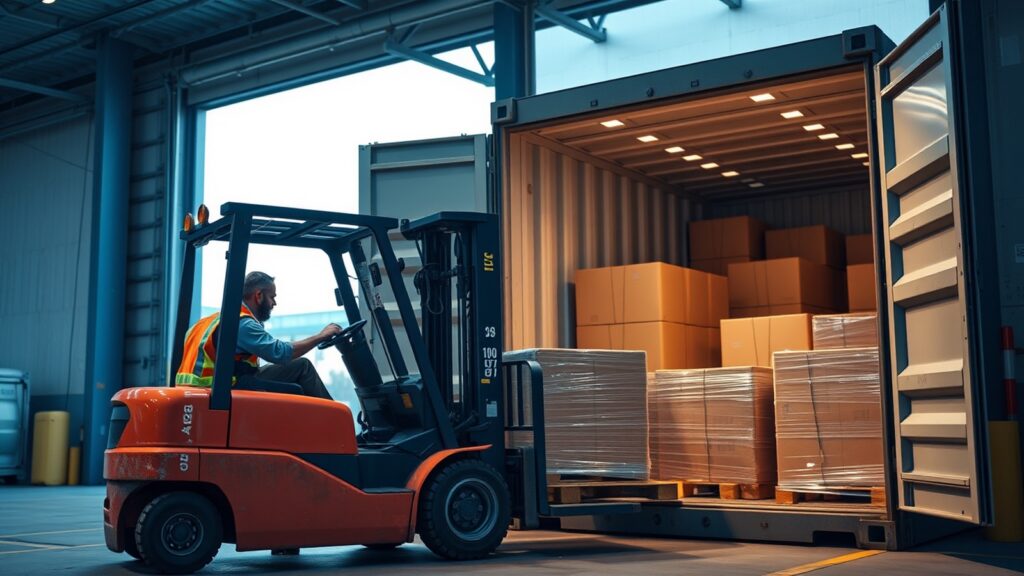
Two factories ship the same product in the same container type — one closes the doors at 66 CBM, the other at 58. The missing 8 CBM is not the box; it is the people planning the stow. Container selection and stuffing are among the few places in ocean freight where money is saved without spending any — worth an hour before booking.
Three workhorse types: nominal vs real
- 20-foot standard (20GP): interior ~5.9 × 2.35 × 2.39 m, nominal ~33 CBM, plan on 25–28 CBM loaded
- 40-foot standard (40GP): interior ~12.03 × 2.35 × 2.39 m, nominal ~67 CBM, plan on 54–58 CBM
- 40-foot high cube (40HQ): one foot taller (interior height ~2.69 m), nominal ~76 CBM, plan on 65–68 CBM
The nominal-to-real gap comes from packing geometry — odd spaces, pallet decks, clearances. Estimate your own: carton volume × count ÷ ~0.85 as a safe load factor, better when carton dimensions are designed against container width. 40HQ usually costs little more than 40GP at sea — for light bulky cargo the extra ~10 CBM is nearly free, so HQ is the default.
Pallets or floor loading?
- Palletized: gives up roughly 10–15% of volume (deck height and edge clearance) for fast handling, lower damage, and the pallet-receiving standard most US warehouses enforce. For buyers with receiving specs or warehouse distribution, pallets are the default
- Floor loading: maximum utilization for large runs of same-size cartons with labor at destination; slower, more crush risk, and manual devanning billed separately
The hybrid is common — floor-loaded tiers below, a few pallets at the door end — balancing cube and unloading, provided weight stays evenly distributed: a container with its center of gravity at one end is a risk at the crane and on the chassis.
Heavy cargo weighs out; light cargo cubes out
Every container has two ceilings — volume and weight — and which you hit first decides the booking:
- Dense cargo (tile, hardware, metal parts, bottled liquids) hits the weight ceiling with cube to spare — “weighs out.” A 40HQ is wasted; a 20GP is often the right box, and splitting one 40GP into two 20GPs can be the safer play
- Light bulky cargo (furniture, plastics, textiles) fills the cube long before the scale — “cubes out.” Go 40HQ, and ask about 45-footers when volume justifies
- Below a full container, the arithmetic returns to the LCL/FCL break-even, with consolidation service as the LCL lane
The overweight red line: the ship can take it, the road cannot
The container’s own max gross (on the door plate, usually around 30 t) is rarely the constraint — US highways are. Cargo plus box plus chassis plus tractor must clear road limits, which nets out to safe cargo weights of roughly 17–19 t in a 20-footer and 19–20 t in a 40 on standard chassis; beyond that means special chassis or overweight permits, with cost and lead time jumping, and state limits differing. For heavy US-bound cargo, give the per-container weight to your forwarder for an inland check before booking — far cheaper than discovering an untowable box at the port. And VGM declaration is mandatory: misdeclared weights mean amendments at best, a missed vessel at worst.
Temperature-controlled cargo is its own world — pre-cooling, setpoints and power gaps are covered in the reefer operations article.
Where SKYCARGO fits
SKYCARGO INC checks the stow math with you before booking: box type against your carton dimensions and weights, load factor, inland weight limits. Send the packing spec and we will confirm what one container really holds. (Personal shipments: Shiptw.)
Interior dimensions and limits vary by container owner and lane. Reference only.