

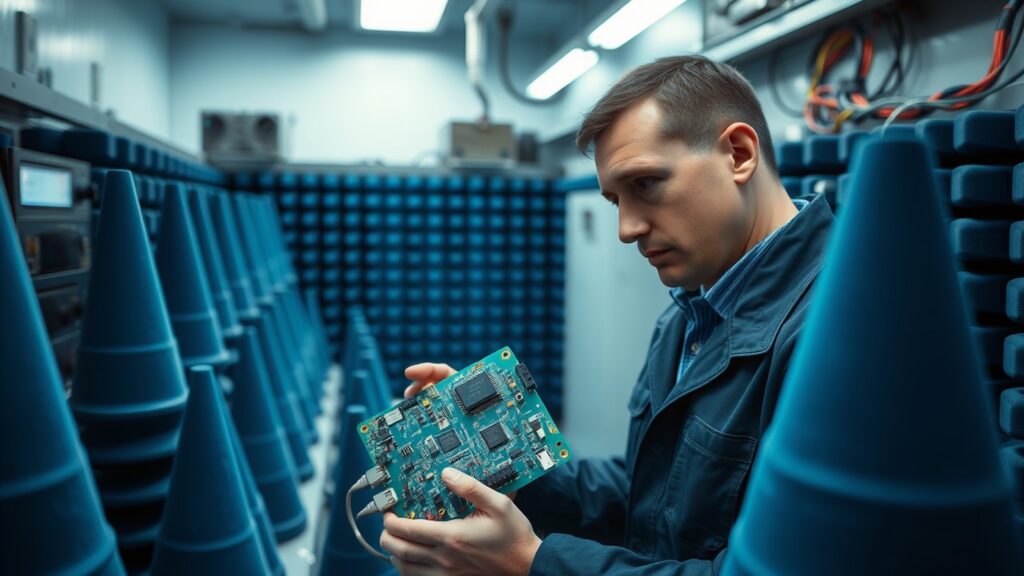
An honest question from a client meeting: “our product has no screen — just a control board. Even this needs FCC?” Yes. Any electronic device that generates radio-frequency energy — and anything with a running clock does — sits inside FCC’s rules. The only question is which track: self-declaration, or certification.
The two tracks: does it transmit on purpose?
- SDoC (Supplier’s Declaration of Conformity): for most electronics without radio transmitters — power supplies, LED drivers, displays, control boards without wireless modules. No FCC review, but self-declaration is not self-persuasion: it requires test reports from a qualified lab against the technical limits, plus a designated responsible party located in the US, identifiable on inquiry
- Certification (an FCC ID): devices with radio transmitters — Wi-Fi, Bluetooth, RF remotes, cellular modules — are intentional radiators and must pass review by an FCC-authorized Telecommunication Certification Body, obtain an FCC ID, and mark it on the device
The rule of thumb: does the device deliberately emit radio? Yes — certification. No — usually SDoC. Drop one Wi-Fi module into the product and the whole determination flips tracks.
At import: compliance is the condition of entry
FCC compliance is not a shelf-listing concern — it is a border threshold:
- The importer must ensure the device complies — part of the filing duty, in the same territory as classification and valuation care
- Marking must be in place: certification track — FCC ID on the unit; SDoC track — the US responsible party identifiable, compliance statements in the documentation
- No compliance basis = detention risk: CBP and FCC coordinate at the border, and an examined shipment that cannot produce test reports or a searchable FCC ID faces detention, re-export or destruction
One aside: devices with screens may use e-labeling to show the FCC ID in a menu — screenless products get no such escape; physical marking stays.
The traps Taiwanese makers hit
- CE as a passport: “we have CE reports” is not an answer at US customs — CE is the EU system; FCC has its own limits, bands and procedures. CE test data may save the lab some work, but the compliance file must be FCC-system
- The sample is not the production unit: the tested sample passed; production swapped a cheaper power IC, revised the layout, changed module vendors — the electromagnetic profile changed with it, and the old test basis is void. Material changes need change management; significant ones need retesting
- A certified module does not certify the machine: buying a Wi-Fi module with an FCC ID does not make the finished product compliant — the integrated device retains its own conditions (antenna configuration, installation restrictions, unintentional-radiator portions)
- A hollow responsible party: the SDoC names a trading company nobody can reach — an unreachable party is an open hole in the file
Like textile labeling, this is a checklist that costs a day in Taiwan — and containers at the US end.
Where SKYCARGO fits
SKYCARGO INC verifies the compliance paperwork face before shipping: which track, whether the FCC ID or test reports exist, whether marking and filing agree. Testing and certification themselves belong with qualified labs and certification consultants. B2B shipments, talk to us. (Personal parcels: Shiptw.)
FCC requirements follow current FCC rules and CBP enforcement practice. Reference only.